Author: Michiel Cremers | Design Craft Consultant at Konzepthaus
Connect with MichielIn this series, I sit down each month with the people building and shaping the Automotive Design tools designers use on a daily.
How do they think about Design craft, about judgement, and about where Automotive Design is heading? Behind the Craft is where you’ll find out, straight from the source.
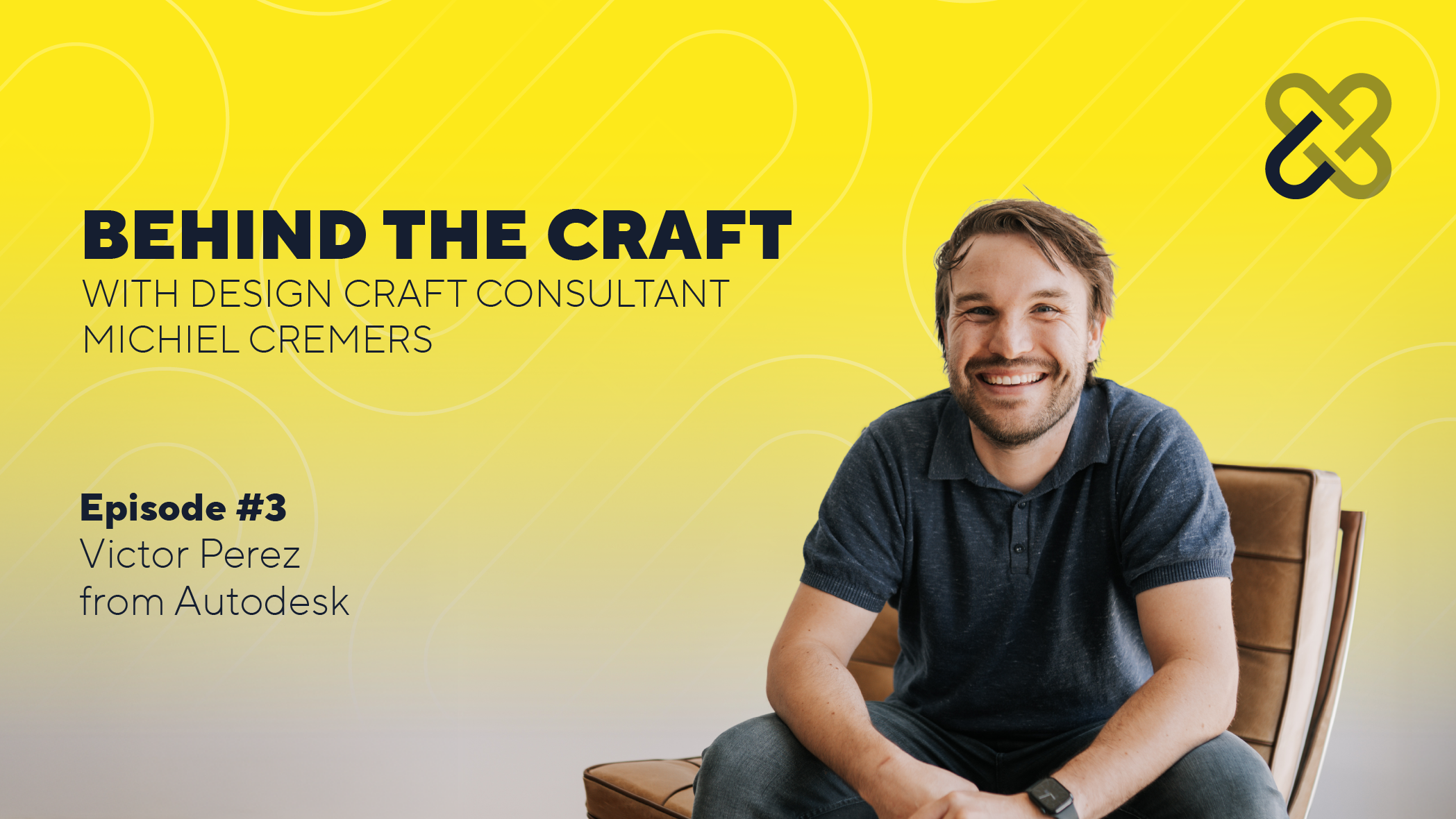
This month’s guest: Victor Perez from Autodesk, who challenged the idea that visualisation is merely about creating the final render. Together, we discussed what technology can take off a designer’s plate, and how removing friction from the process might actually give designers more agency over the decisions that matter.
XR Sales Engineer
Autodesk

Victor Perez is a XR Sales Engineer at Autodesk in Munich. He works at the intersection of spatial computing and real-time visualisation, building AI tools inside Autodesk VRED that let vision-language models actually see and react to a 3D scene. Speaking soon at AU 2026 on where VRED and AI are headed.

Autodesk is trusted by the world’s designers, engineers, builders, and creators to help them design and make anything. From the buildings we live and work in, to the cars we drive and the bridges we drive over. From the products we use and rely on, to the movies and games that inspire us.
Autodesk’s Design and Make Platform unlocks the power of data to accelerate insights and automate processes, empowering our customers with the technology to create the world around us and deliver better outcomes for their business and the planet. #MakeAnything.
Let’s dive into the third episode of Behind the Craft!
That visualisation means being ‘the render guy’.
People assume visualisation is a service at the end of the funnel. You finish the design, you hand it over, you get a pretty picture back. The reality: by the time something looks good in VRED, most of the interesting decisions are already made. Visualisation is most valuable before that, setting up an environment where a designer can see consequences of a choice while the choice is still open.
Underneath it is the same misconception: that the visualisation is the deliverable. The real deliverable is a faster, more honest feedback loop. Tools are just how I get there.
The offline render is dying as the unit of work. Not because renders stop mattering, but because the loop is collapsing. Model – evaluate – iterate is becoming one continuous state instead of three handoffs. Real-time stops being the “preview” and becomes the thing you actually judge on.
AI’s real role is boring and enormous: it removes the tax. Data prep, format conversion, scene assembly, variant setup, the hundred small chores between I have an idea and I can look at it. In every hour you claw back there is an hour of actual designing.
Pipeline thinking. Schools teach tools as islands: modelling another, presentation in a third. Nobody teaches how dataflows, degrades and gets rebuilt between them. That’s most of the actual job, and graduates learn it the hard way in their first year.
Visualisation and XR is a critique skill, not a beauty shot. Very few learn to stand next to a 1:1 model with a headset and interrogate it. What to look for, how to walk it, how to run a review that produces decisions instead of compliments, and honestly, even how to explain a decision. The technical side is learnable. But defending an idea in a room full of people who disagree, that’s a skill that moves things forward.
The pattern I see over and over: it isn’t a new tool that unlocks someone, it’s the moment the tool stops being in the way.
A designer who’d reviewed models on screen for years put on a headset and walked around it at 1:1 for the first time. Within a couple of minutes, they’d spotted something about the proportion that no screen review had surfaced, and they weren’t tentative about it, they knew immediately. Weeks of review cycles compressed into a walk around a car that didn’t exist.
That’s the actual lesson for me: “unlocking moments” aren’t caused by capability, they’re caused by the absence of friction. My whole job is removing enough friction that the designer’s own eye can do what it already knows how to do.
“What are you deliberately choosing not to automate?”
My answer: the hand sketch, the judgment, proportion and stance, the emotion in a surface, what the car should mean.
I can automate everything that leads up to that decision, and nothing about the decision itself. Automating the boring parts makes the judgment more exposed, not less. When you can’t hide behind “we didn’t have time,” you have to actually be right.
What I keep coming back to is what Victor said about what he deliberately chooses not to automate: the judgment itself. Proportion, stance, the emotion in a surface, what the car should mean. He can automate everything that leads up to that decision, and nothing about the decision itself.
Automating the boring parts makes the judgment more exposed, not less. When you can no longer hide behind “we didn’t have time,” you have to actually be right.
That also seems to be the general sentiment in the industry, and the thread running through what I have written on here and on social media so far this year.
With AI, the tools can generate 200 sketches, but choosing the 2 that deserve development is judgment. With CMF, the software can visualise any material, but knowing how it will feel and age is judgment. And now with VR, you can stand next to a car that does not exist yet, but knowing which decisions belong in the headset and which still need the real world is judgment.
The tools keep getting better at removing the effort, the setup, the friction. What they leave standing in the open, every time, is the designer’s eye and the final call.
That is not a coincidence. It is the whole point.
Check out the Haus of Learning VRED | Automotive Essentials course, and many more!
Explore more of our Learning offersSign up to your regular dose of everything Mobility Design:
deep insights, practical tips, and news on upcoming events.