Author: Michiel Cremers | Design Craft Consultant at Konzepthaus
Connect with MichielIn this series, I sit down each month with the people building and shaping the Automotive Design tools designers use on a daily.
How do they think about Design craft, about judgement, and about where Automotive Design is heading? Behind the Craft is where you’ll find out, straight from the source.
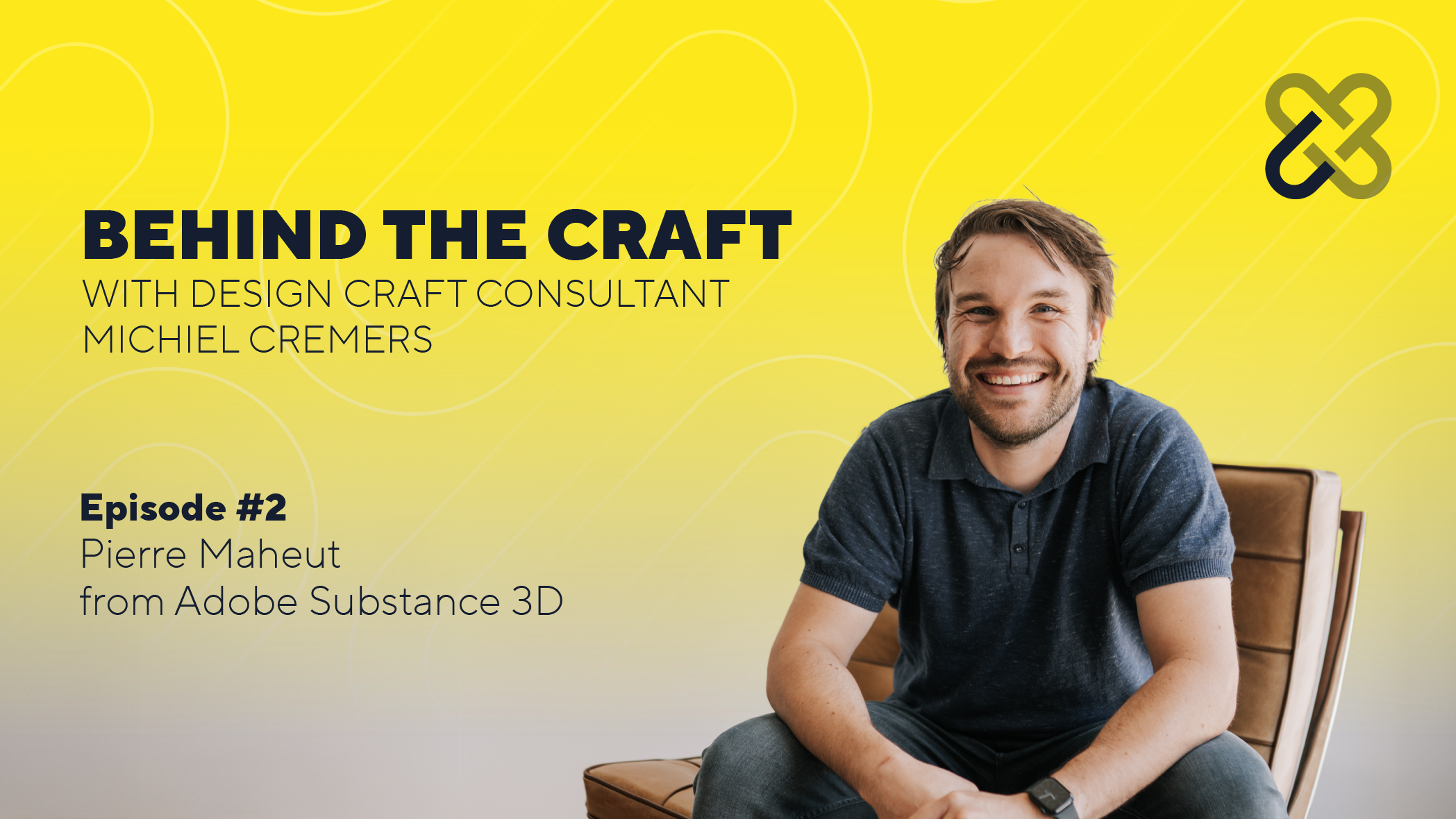
The second guest: Pierre Maheut from Adobe Substance 3D, who sat down with me to talk about what happens to CMF and Material Design as it moves onto the screen, and how you hold onto the feel of real materials when so much of the work now happens digitally.
Director, Growth, 3D & Immersive
Adobe

Pierre is Director of Strategic Initiatives and Partnerships for Adobe Substance 3D.
With a background in mechanical Engineering and Industrial Design, he has spent his career helping bridge Design, Technology, and Innovation.
Before joining Adobe, he worked at Dassault Systèmes on CATIA solutions for Industrial and Transportation Designers.
Today, he focuses on bringing digital material creation, real-time visualisation, and immersive technologies to industries ranging from Automotive and Product Design to Fashion and Manufacturing.
Adobe Substance 3D is the leading solution for digital material creation and 3D texturing.
Used by more than 95% of AAA game studios, Substance has expanded into Automotive, Product Design, Fashion, Architecture, VFX, and Manufacturing.
The tools enables designers to create realistic digital materials and digital twins that can be used across design reviews, marketing content, AR/VR experiences, and digital commerce, while integrating seamlessly with the broader Adobe Creative Cloud ecosystem.
Let’s dive into the second episode of Behind the Craft!
There are two common misconceptions about Adobe Substance 3D.
The first is that Substance is only about procedural, node-based material creation. While Substance Designer is indeed one of the leading procedural authoring tools, the Substance ecosystem goes far beyond that. We also provide scan-based workflows and dedicated tools such as Substance 3D Sampler, designed specifically for CMF Designers. Sampler allows designers to digitise and explore real-world materials, create textile variations, experiment with colors, patterns, embroidery, and finishes, and prototype material ideas before physical production.
The second misconception is that Substance is only for the video game industry. We are proud that more than 95% of AAA game studios use our tools, but today the same technologies are used across Transportation Design, Consumer Products, Fashion, Architecture, VFX, and Manufacturing. Increasingly, CMF Designers are discovering that digital material design tools such as Adobe Substance 3D can become as essential to their workflow as Alias is for automotive form development or Figma is for UX design.
Ultimately, our goal is to give designers a digital playground where they can explore materials, finishes, and experiences before committing to physical prototypes.
Several major shifts are shaping the future of Design.
The first is sustainability. Designers are increasingly considering the entire lifecycle of a product, from sourcing and manufacturing to reuse, recycling, and circularity. Material choices are becoming strategic decisions rather than purely aesthetic ones.
The second is the rise of automation and AI. These technologies are removing many repetitive tasks, allowing designers to spend more time on creative exploration, storytelling, and decision-making. The opportunity is not simply to work faster, but to think broader and test more ideas.
Finally, immersive technologies are becoming far more accessible. Today, a designer can bring a concept into a real-time or immersive environment, such as Apple Vision Pro, without needing to be a deep technical expert. As visualisation becomes easier, the value shifts toward vision, judgment, and the ability to communicate compelling experiences.
The designers who thrive will be those who combine creativity, technical curiosity, and a willingness to continuously learn.
More than any specific software or technology, I wish Design education focused on teaching students how to keep learning.
The tools, workflows, and technologies used by designers have changed dramatically over the past decade and will continue to evolve. The most successful professionals are not necessarily those who mastered a particular tool at school, but those who developed the habit of continuously expanding their skills throughout their careers.
I would also like to see stronger foundations in CMF Design across all Design disciplines. Every designer should understand the fundamentals of colour theory, materials, manufacturing processes, finishes, and graphics. These elements influence how people perceive products and experiences, regardless of whether someone specialises in Transportation, Product, Interior, or UX Design.
Design education should prepare students not only to create objects, but to understand the complete relationship between materials, manufacturing, business, and user experience.
One of the most memorable moments came during a collaboration between Adobe Substance 3D, Rivian, and ArtCenter College of Design.
We brought together teams of students from different disciplines: Transportation Design, Interior Design, Product Design, and CMF Design. In just a few weeks, they were able to combine their complementary skills and create highly compelling concepts for Rivian.
What struck me most was how quickly many students discovered the strategic value of CMF Design. Materials were no longer treated as a final visualisation step. Instead, they became a core part of the design story, helping define the identity, emotion, and functionality of the concepts.
The breakthrough came when they stopped thinking in silos and started building on each other’s expertise. That combination of collaboration, curiosity, and access to the right tools unlocked a level of creativity that would have been difficult to achieve individually.
People rarely ask me what I enjoy most about my job.
The answer is simple: the opportunity to move between industries and learn from incredibly creative people. Early in my career at Dassault Systèmes, I could be working on an automotive project like the Pininfarina Sergio one day, then discussing aerospace the next, and consumer products shortly after.
That constant exposure to different ways of thinking was fascinating.
With Adobe Substance 3D, that diversity expanded even further. I’ve had the chance to work with professionals from Gaming, VFX, Animation, Architecture, Footwear, Fashion, and Industrial Design. Each industry has its own tools, processes, and challenges, yet they’re all connected by the same goal: using creativity to tell stories, solve problems, and create experiences that resonate with people.
What continues to inspire me is seeing how these worlds influence one another. The best ideas often come from unexpected places.
If I could share one piece of advice, it would be this: stay curious. Don’t limit yourself to your own discipline. If you’re a Transportation Designer, visit a fashion show. If you’re a Product Designer, attend an air show. Explore Footwear, Architecture, Gaming, Filmmaking – anything that exposes you to different creative perspectives. Innovation often happens at the intersection of industries.
And one personal recommendation: watch Light & Magic on Disney+. It’s a fantastic reminder of what can happen when technology, creativity, and curiosity come together.
What stuck with me the most: Materials are not the final layer, they are part of the story.
It connects directly to my post I about CMF that i wrote this week. That CMF is too often treated as a premium finish added at the end, once the big decisions are already made, when it deserves real strategic weight much earlier in the process.
Pierre described watching that shift happen live. In the collaboration between Adobe Substance 3D, Rivian and ArtCenter, what struck him most was how quickly students stopped treating materials as a final visualisation step and started using them to define the identity, emotion and function of their concepts. Materials became part of the design story, not a coat of paint on top of it.
That is the whole argument in miniature. When CMF enters early and is understood as strategic, it stops being decoration and becomes part of what a product actually is. The tools are getting better at helping designers explore this sooner. The judgment about what those materials should say still comes from the designer.
Check out the Haus of Learning Substance Designer | Automotive Essentials course, and many more!
Explore more of our Learning offersSign up to your regular dose of everything Mobility Design:
deep insights, practical tips, and news on upcoming events.