Although AI in Recruiting is changing the way HR teams work, there is a difference between finding a candidate who matches a job description and finding the right fit for a team. So, where can AI genuinely make the recruitment process easier? And where should humans take the lead?
Used well, AI can give Talent teams a clearer overview of the talent pool, reduce manual work to allow for more in-depth conversations, and make the overall recruitment process more efficient without taking the decision-making out of the hands of the Talent team.
These are tasks where AI can support the hiring process:
Screen candidates
AI can quickly scan large numbers of applications for keywords, identifying information such as experience, skills, job titles and qualifications against predefined criteria to narrow down the candidate pool to those who (initially) appear most relevant.
Process data
By processing large amounts of candidate and recruitment data much faster than a person, AI helps identify recurring patterns across applications, skills, experience or hiring activity, and supports more informed decisions.
Automate admin tasks
From scheduling interviews and sending routine communications to updating candidate records, AI can take care of many repetitive administrative tasks and free up time for decisions that require human judgement.
Streamline workflows
AI can connect different steps of the recruitment process, helping organise candidate information, prioritise tasks and keep applications moving through the pipeline.
The problem of artificial intelligence in hiring begins when a decision becomes entirely dependent on what can be easily measured and put into keywords.
Understanding the candidate
A CV tells you where a candidate has worked, what their job title was, how many years they have been in the industry and, if you’re lucky, a little about what they actually did.
What it doesn’t tell you is how a person thinks, how they work with a team, what kind of environment and motivation brings out their best work, what their goals are, or whether they would actually fit into your studio.
Understanding the company
Sometimes, the organisation tells you they need one thing, but after several conversations it becomes clear that what they really need is something different.
That’s where years of experience come in to truly assess the culture and dynamics within a team, its creative vision, and what it’s actually missing.
To underline the difference in the approach of AI compared to the approach of humans to the hiring process, here’s an example: AI Screening vs. the Konzepthaus Talent Team Screening.
The role was a Senior Exterior Designer, with a minimum requirement of five years of experience. Unfortunately, our imaginary candidate Max had only four.
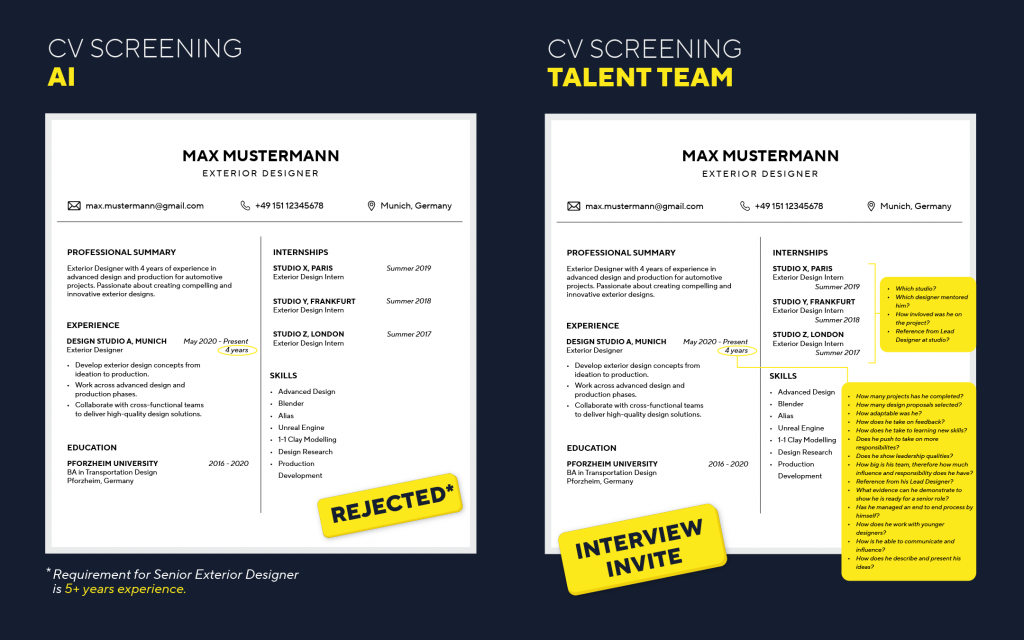
If the AI screening process starts and ends with the job description, the decision seems obvious. Max didn’t match the predefined criteria of five years experience. He was one year short, so he was out.
Instead of rejecting the candidate based on one number, our Talent Consultants read between the lines, saw potential, and invited Max to an interview.
In that conversation, they were able to fully understand the depth of the candidate’s experience. His four years in the industry included unusually broad project responsibility and already having helped less experienced designers move projects forward. So, although he was one year short of the required amount of experience, he was more than ready to step into the responsibility of the role.
Beyond that, the Talent Consultants took the time to be able to recognise another layer to a good fit that AI cannot comprehend: the Max way of thinking, motivation, and approach to collaboration were a strong match for the studio’s mindset and team dynamic.
The number put on the candidate’s experience hadn’t changed, but the context had. And someone who AI would have filtered out at the first stage actually turned out to be exactly the person the client was looking for.
AI can make the recruitment process more efficient by taking care of volume, data and repetitive tasks. For that to work, Talent teams need to understand how the systems work and what their results actually mean. Without human involvement and oversight, it can create a different set of problems. But used properly, AI can be a valuable support in parts of the recruiting process.
What it can never replace, however, is human judgement. Taking the time to look beyond a CV to see the person behind it, spotting potential that isn’t immediately obvious, evaluating what someone could bring to a particular team, and ultimately deciding whether the match is right.
Let AI help with the volume, let humans handle the nuance.
Sign up to your regular dose of everything Mobility Design:
deep insights, practical tips, and news on upcoming events.