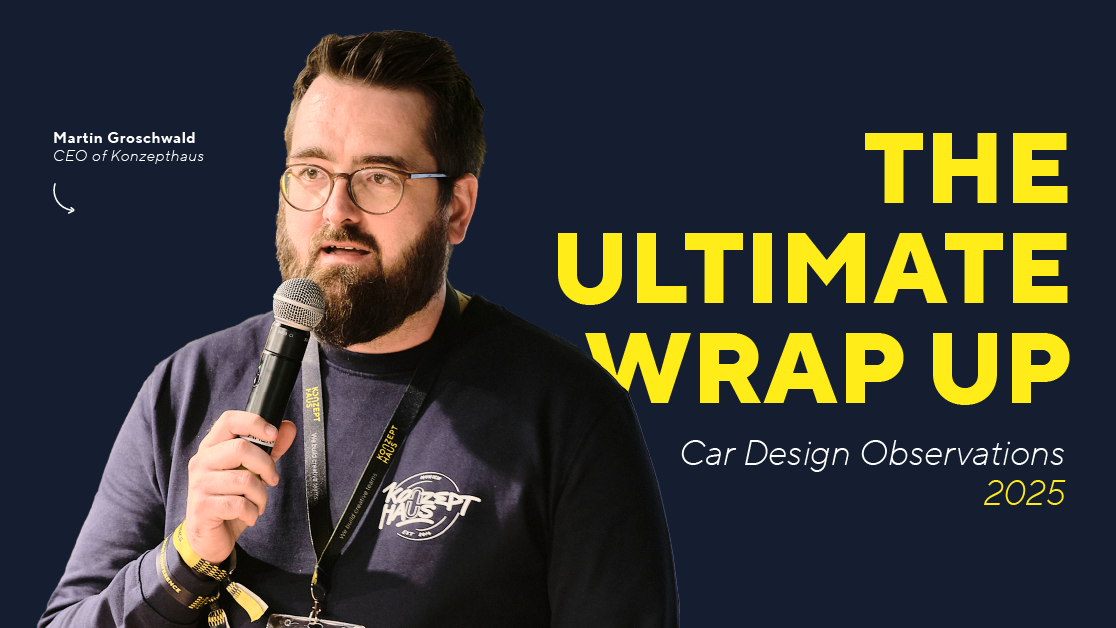
To me, looking back is never really an easy thing because the team and I here at Konzepthaus are constantly looking forward.
So when my colleague asked me if I could write up some observations and learnings from 2025, I had to take a bit of time to reflect. And to be honest: After writing this “little” piece, it really felt like I should do it more often.
The beginning of last year was kind of strange, as it started a bit slower than usual. But suddenly, it got to such a speed towards the end, it felt like we were catapulted back to pre-covid times when you didn’t know what’s going on around you. Now, there is a buzz going into 2026 that feels really exciting. More about that a bit later.
I won’t jump into anything related to the best concepts or production cars. That’s been done by so many others, thoroughly. Instead, I’ll focus more on the topics that might not have been too present, but have still shaped 2025 within the car design world.
And the first one, ironically, is Artificial Intelligence. AI has been everywhere last year. Across the world, across industries, across social media feeds. To the point where many of us are probably thinking the same thing: aren’t we a little tired of it? What’s interesting is that, while others have been praising AI, the car industry has been shying away from it – mostly because for many, it’s more an IT risk than any help in facilitating processes or a strategic asset in making better decisions. Have there been experiments and tests? Sure! But have these pilots actually made it into the day-to-day business? Not really, despite what you hear in the “press”. And what AI, so far, has failed to do is to create more time for designers to think and ideate. The potential is certainly there, but, at least creatively, our industry still has a long way to go to see a proper impact.
On top of AI, 2025 has exposed a lot of educational struggles. Transportation Design courses are expanding globally, the business of traditional car design education is flourishing. And yet, entry-level jobs are nearly non-existent. While car design studios and departments are evolving rapidly, the education is standing still, continuing to do what it has done for decades. At the same time, the buzzword I’ve heard again and again from Design Chiefs this year: craftsmanship. Students may leave their schools equipped with superb skills on tools, but the fundamental understanding of how to actually build a car? That’s getting lost. It’s a catch-22 that needs to be stopped. Otherwise, we’re simply flooding the industry with talent that has no real chance to break into it. I understand that schools need to make money. But is it right to generate this money from selling a dream, rather than teaching what is needed in reality? Maybe a bit more elitism is what we need here.
From a mindset perspective, I had several very inspiring and controversial conversations these past 12 months. But one really stuck with me, especially one sentence: “We forget how to dream at the moment”. The reason for that is not because design teams aren’t creative, but because more and more satellite studios are being shut down (sometimes rightfully, sometimes incomprehensibly). The consequence: there is little to no time to experiment, to think, to explore, or to simply enjoy the fun of letting your mind and ideas wander. We can clearly see less investment in the free-spirited and thinking approaches. Most projects are programmes and part of a vehicle line, and many design teams are tending to move towards being internal suppliers for bodies and shells. The term “sketch monkey” has made its comeback in 2025, and that’s not a good sign.
When it comes to structures, however, we have seen some very positive directives within the car design world last year, and they should give us a lot of hope for 2026 and beyond. Despite my previous criticism, there is a push and wish from C-level executives that design takes more responsibility of the brand and experience. Not necessarily to own both in all its complexity and execution, but more and more OEMs are trusting their Chief Designers to also take on the role of Creative Director for Brand and Experience, i.e. to not just create a design vision for the inside or outside of the car, but to transport this vision across all touch points of the brand. And while this is still in its infancy, especially after the very first tries of Chief Design Officers have often not been defined and implemented properly in the complex OEM system and Design has to grow its understanding of Business to fully reap the benefits of merging these roles into one, it is very encouraging that there is some movement to lift Design into the highest spheres once again.
Alongside this, we’re also seeing a trend that some may find controversial, depending on which side of the fence they’re on: the decrease of management levels to enable faster and better decisions. OEMs tend to operate with a large number of management levels, in most cases too many. An artificially created hierarchy system that more allows for people to carry fancy titles rather than making good decisions for the project. And while this might be necessary in big companies (often due to the lack of clear expert paths), many managerial roles exist without any decision-making power at all. Over the past year, we’ve been directly and hands-on involved in several projects aimed at reducing management levels within design departments to a minimum, and it was impressive to see the improvements in the design process that came from it. There is still much to learn, but recognising that we don’t need ten supporting roles for one designer is a great outlook for a better design organisation. One where ideas can actually break through, rather than constantly being put down.
Earlier, I mentioned the trust placed in Chief Designers when it comes to defining a brand’s creative direction. What was missing, however, is a bit of perspective. Because this newly found responsibility doesn’t necessarily come with the role or the recognition to match. In several cases last year, we’ve seen Chief Design Officers, or similar roles, being replaced, and their successors being installed a level below, forced to prove their worth before working their way back up the ladder. It suggests that while the C-level to some extent comprehends the value of Design in the organisation, we’re still failing at proper succession planning. Even more frustrating might be the lack of interest from HR and the C-level alike in strategically developing creatives not just as department leaders, but as business leaders. As Design becomes more deeply involved in Brand, and also Marketing, these improved development paths for creative leaders (and I don’t only mean traditional car designers) to be truly implemented in the highest-level decision-making processes are urgently needed. Creative talent is one thing, but compared to Engineering, Marketing, or Manufacturing, Design continues to lag in systematically preparing these talents for top-level responsibility. And this issue cannot be solved by current leaders alone. It requires respect, understanding, and genuine engagement from Heads of HR, Chief People Officers, and alike. Design is not a copy-and-paste department that fits into generic assessment centres.
A couple more thoughts on random things that I have observed in 2025. The first and, for me, most disappointing: Car Design Journalism is dead. I used to love delving into magazines, newspapers, and online blogs. But nowadays, almost everything you can read is sponsored in one way or another, or just a rephrase of a press release. No discourse, no debate, no critique. Most outlets, understandably, don’t want to bite the hand that feeds them. And with subscriptions going down consistently, the focus to make money now lies more on events and their sponsors. While I am in no way condoning events (we at Konzepthaus, as you may well know, host many ourselves), I do believe our industry is missing an independent outlet that allows for controversial discussions. What that needs, is confidence. And I deeply hope that OEMs regain the courage to open up towards an honest, respectful exchange of opinions – good and bad – in a space where they can transparently report their decisions. Design can, and should, be debated not only behind closed doors, but publicly. And if we as a community don’t have that chance, one has to ask: why would we need any reporting at all?
To end this look back on a more positive note, I would like to highlight a car show that really stood out this year. Over the last 12 months, I visited what I’d consider the last traditional car shows in Shanghai, Munich, Tokyo, and LA (Goodwood was fun but needs to reinvent itself as it’s more about the car culture in general, which is fun in itself, but certainly not really about car design and community). Out of these four, the IAA Mobility in Munich absolutely stood out. Although the Japan Mobility Show in Tokyo also truly impressed, it was largely carried by Toyota and Honda. The show in the Bavarian capital, however, has found the perfect mix: presenting cars, concepts, and new ideas from an incredible fleet of brands to the audience in a uniquely open and inclusive space, while complementing the experience with side-events all about vehicle design, car culture, automotive history, and everything in between. There’s a clear forward path for Munich, and I think the city has proven that it can attract the crowd. I’m convinced we’ll observe an even stronger increase in OEMs joining us here in the future. On a side note, there is also quite some hope for Paris this year as well. If it takes a few cues from Munich, that could be a real win for the European car industry and its design community.
All in all, 2025 was certainly not boring. It may have been a little bit less busy on many ends, and we have seen some victims throughout the year that were hit by certain company struggles. But despite the challenges, I am very much looking into 2026 with genuine excitement and positivity.
Speaking of, let’s look at a few predictions for this year ahead of us that might, or might not, come true.
Sign up for our newsletter and be the first
to know about our events.